Social Media Marketing
Social Media Manager vs. Marketing Agency: Which Is Right for You?
Should you hire an in house social media manager or partner with a marketing agency? Compare cost, skills, consistency and results to make the right call.
 Tushar MondalCEO & Founder
- Published
- Reading time
- 6 min read
Listen · 6 min
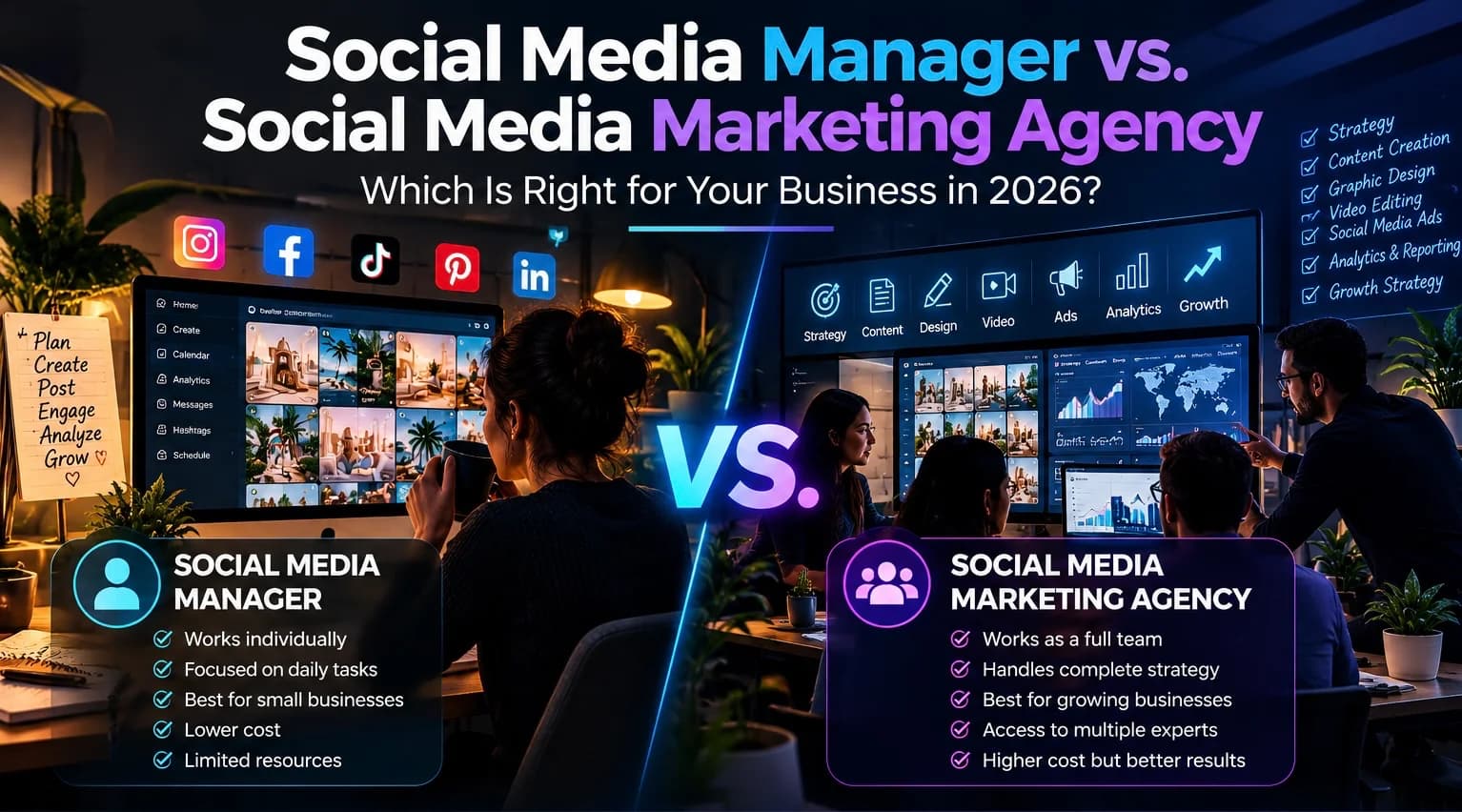
If you are trying to grow your brand on Instagram, Facebook or LinkedIn, you have probably hit this crossroads: do you hire a social media manager to work in house, or do you hand the whole thing to a social media marketing agency? The honest answer is that it depends on your budget, your workload and how many skills you need. A single hire gives you dedicated attention. An agency gives you a full team, a proven process and usually better value at the small to midsize business stage. This post walks you through the real differences so you can decide with confidence.
What Each Option Actually Looks Like
Before comparing, it helps to be clear about what you are buying in each case.
A social media manager is one employee (or freelancer) who owns your social presence. They plan content, write captions, post, reply to comments and report back. In a small company they often double up as the person doing email marketing, basic design or even customer support.
A social media marketing agency manages your presence end to end as a service. At Perfection International, for example, that means strategy, a monthly content calendar, content creation, scheduling and publishing, plus community management so no comment or enquiry goes unanswered. You get a team behind the account rather than one person.
The distinction matters because most hiring mistakes happen when a business expects one person to do the work of five.
The Skills Gap Nobody Talks About
Good social media marketing is not one job. It is at least five:
Strategy: deciding which platforms to be on, what to say, and how social supports actual revenue
Copywriting: captions and hooks that stop the scroll
Design: graphics and carousels that look like your brand, not a template
Video: short form video and reels, which now drive most organic reach
Community management: replying to comments and DMs fast enough that enquiries turn into sales
When you hire one social media manager, you are hoping to find all of this in a single person, plus the willingness to do it every day without burning out. Those people exist, but they are rare, and they know their market rate.
An agency spreads the work across specialists. The person writing your captions is not the person editing your reels, and neither of them is the person pulling your monthly report. The output is usually stronger because nobody is doing a job they are average at.
The Real Cost Comparison
Most business owners compare an agency retainer to a salary and stop there. That misses the hidden costs of an in house hire:
Recruitment time: writing the job post, interviewing, onboarding. Weeks of your life before a single post goes live.
Tools: scheduling software, design subscriptions, stock assets, analytics tools. An agency absorbs these; an employee expects you to provide them.
Management overhead: someone has to brief them, review their work and set direction. If that someone is you, factor in your own hours.
Cover: people get sick, take leave and resign. When your one social media person is away for two weeks, your accounts go quiet.
Training: platforms change constantly. Keeping one employee current is your responsibility and your cost.
An agency retainer bundles all of this. You pay one invoice, and the team, tools, process and continuity come with it. For most small and midsize businesses, the total cost of a capable in house hire ends up close to, or above, an agency retainer, with more risk attached.
Consistency: Where In House Hires Struggle Most
The single biggest killer of social media results is inconsistency. Posting five times one week and zero the next two teaches the algorithm and your audience to ignore you.
In house, consistency depends on one person's discipline and workload. The moment something urgent happens elsewhere in the business, social slips, because it rarely feels urgent until the damage is done.
Agencies run on a content calendar. Content is planned a month ahead, created in batches, approved by you before anything goes live, and scheduled in advance. Publishing happens whether or not anyone is having a busy week. That rhythm, more than any single creative idea, is what grows an account.
When Hiring In House Is the Right Call
An agency is not the right answer for everyone. Hiring a social media manager makes sense when:
You are a larger company with enough daily work to keep a specialist fully occupied
Your product changes fast and content needs someone physically present, shooting and posting in real time
You already have a marketing team and just need one more pair of hands executing a strategy that already exists
You have the budget for a senior hire, not a junior learning on your dime
If you recognize yourself in that list, hire. If not, read on.
When an Agency Is the Smarter Move
An agency is usually the better fit when:
You need strategy, not just posting. You want someone to tell you which two or three platforms your customers actually use, rather than spreading thin across all of them.
You want professional content, graphics, carousels, reels and captions, without buying software or hiring a designer and video editor separately.
You cannot afford for social to stop when one person is unavailable.
You want accountability: a monthly report covering reach, engagement, follower growth and the enquiries social brought in, plus a clear statement of what changes next month.
You would rather approve content than create it.
That last point surprises people. A good agency does not take your brand away from you. You approve everything before it goes live, and if you have product photos or footage, the team uses them. You keep control without carrying the workload.
The Hybrid Option Worth Considering
Some businesses land on a middle path: a junior in house coordinator who handles quick, in the moment content and forwards enquiries, while an agency owns strategy, the content calendar and production. This works well once your social presence starts generating real enquiry volume and someone needs to respond within minutes during business hours.
If you are not there yet, start with the agency. You can always bring coordination in house later, using the playbook and calendar the agency has already built for you.
Questions to Ask Before You Decide
Whether you are interviewing a candidate or an agency, these questions will tell you most of what you need to know:
What exactly is included each month? Vague answers mean vague output. You want specifics: number of posts, formats, platforms, and whether community management (replying to comments and messages) is in scope.
Who creates the content? If the answer is "you send us photos and we post them," you are buying a scheduler, not a marketing partner.
How do you report results? Look for reach, engagement, follower growth and enquiries, plus what they will change next month. Likes alone are not a business metric.
What happens when you are unavailable? An agency should have a team answer. A freelancer will go quiet.
Which platforms do you recommend for us, and why? A good answer names your customer, not a list of every platform that exists.
The Bottom Line
Hire an in house social media manager when you have the workload, budget and management capacity to support a dedicated specialist. Hire a social media marketing agency when you want strategy, content creation, publishing and community management handled as one reliable system, without the recruitment, tools and continuity risks of a single hire.
For most growing businesses, the agency route delivers more skills, more consistency and more accountability for a comparable total cost. And because everything is planned on a calendar and approved by you before it goes live, you stay in control of your brand the whole way.
Know someone who should read this?
Written by
Tushar Mondal
CEO & Founder
Web and mobile app developer for Android and iOS.
More from Tushar →
Related service
Social Media Marketing
Grow and engage your audience
See how we help →
See it in action
Game day social content for Oklahoma City Spark
7 Supplied assets. Social media content creation and video editing for an AUSL softball team.
Read the Oklahoma City Spark (AUSL) case study →