Social Media Marketing
How AI Is Changing Social Media Marketing in 2026
AI now shapes everything from content creation to ad targeting. Learn what actually changed in social media marketing in 2026 and how to use it well.
 Tushar MondalCEO & Founder
- Published
- Reading time
- 7 min read
Listen · 7 min
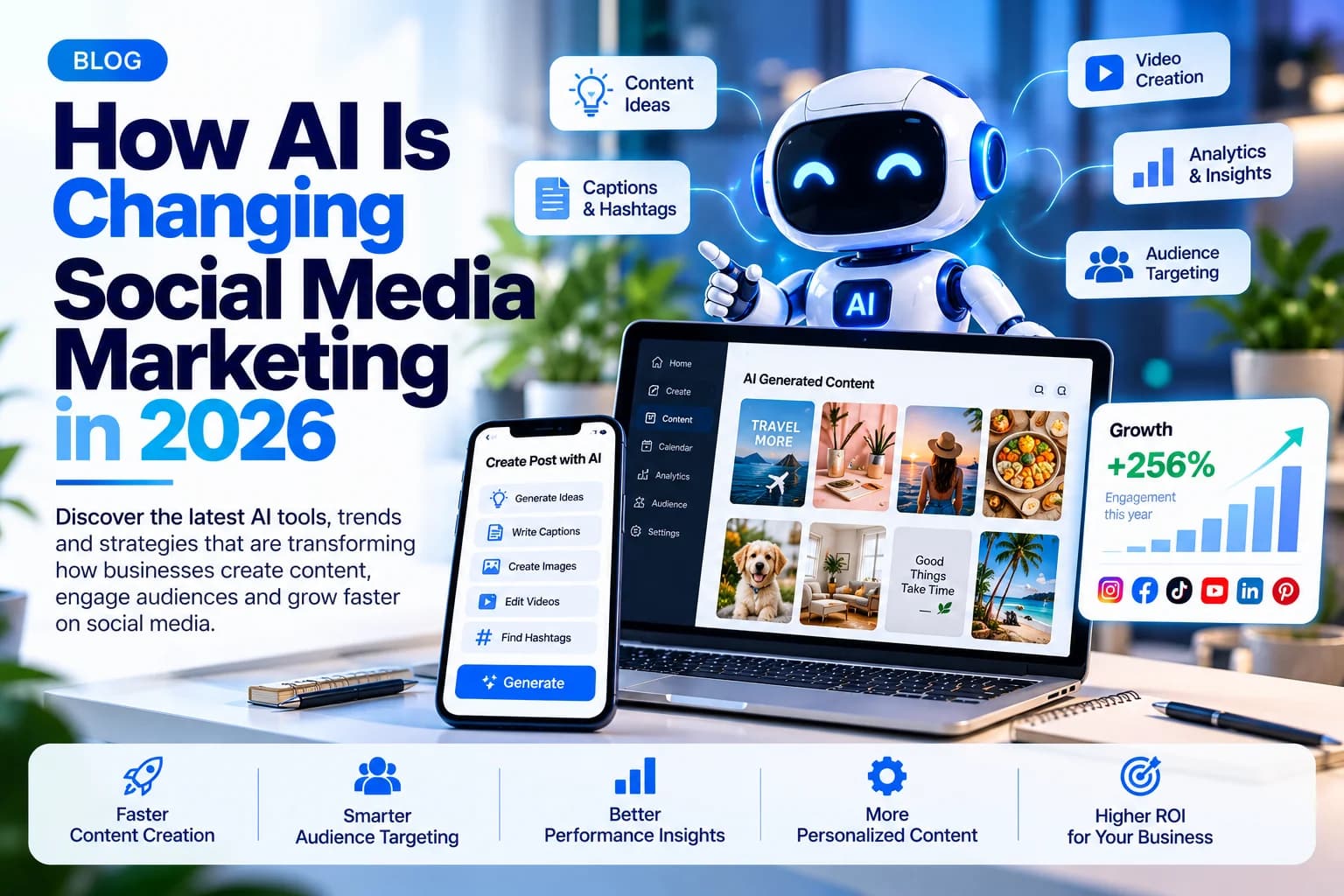
AI is changing social media marketing in three big ways: it speeds up content creation, it makes ad targeting smarter, and it helps brands reply to customers faster. But it has not replaced the need for strategy, taste, or a real human voice. The brands winning on social in 2026 use AI as a powerful assistant, not as the whole team. Here is what has actually changed, what still needs a human, and how to use AI without losing what makes your brand worth following.
Content Creation Is Faster, But Standing Out Is Harder
The most visible change is in how content gets made. Tools built into platforms and apps like Canva can now draft captions, suggest hooks, generate images, and cut video clips in seconds. What used to take a small team a full day can now be drafted in an hour.
That sounds like pure good news. The catch is that everyone has access to the same tools. When every business in your category can produce decent content quickly, decent content stops being enough. Feeds in 2026 are full of polished, generic posts that all feel the same.
So the bar has moved. Volume and polish are now the baseline. What earns attention is a point of view, a recognizable voice, and content that clearly comes from a real business with real experience.
What AI does well in content creation
First drafts. Turning a rough idea into three caption options or a carousel outline saves real time.
Repurposing. Cutting one long video into several short clips, or turning a blog post into a week of posts.
Variations for testing. Making five versions of a hook or headline so you can see which one lands.
Basic design and editing. Cleaning up images, generating simple graphics, and formatting content for each platform.
What still needs a human
Knowing which ideas are worth posting in the first place.
Writing in a voice that sounds like your brand, not like everyone else.
Spotting the angle that will actually make your specific audience stop scrolling.
Deciding what not to post.
The practical approach is to let AI handle the drafting and formatting, then have a person shape, edit, and approve everything. Speed from AI, judgment from people.
Social Listening and Trend Spotting Got Smarter
AI can now scan huge volumes of posts, comments, and conversations to tell you what your audience is talking about, what they are frustrated with, and which topics are gaining traction. This used to require expensive tools and a lot of manual reading. Now it is faster and more accessible.
For a business owner, this means you do not have to guess what content to make. You can see the questions people are already asking in your space and answer them. You can spot a rising trend early enough to join it while it still feels fresh, rather than two weeks late.
The risk is chasing every trend the tools surface. Not every trending topic fits your brand, and jumping on the wrong one makes you look like you are trying too hard. Use AI to see what is happening, then use human judgment to decide what is worth your voice.
Ad Targeting Is Now Mostly AI Driven
If you run paid social, this is the biggest shift. Platforms like Meta have moved heavily toward AI driven targeting. Instead of you manually stacking interests and demographics, you increasingly give the system your creative, your goal, and a broad audience, and its AI finds the people most likely to respond.
This changes where your effort goes. When the algorithm handles the targeting, the thing you control most is the creative itself: the image, the video, the hook, the offer. Strong creative now does more of the heavy lifting than clever audience settings.
It also means testing matters more, not less. Because the AI learns from results, you want to feed it several different creative options and let it find winners. The businesses that struggle with paid social in 2026 are often the ones running one ad and hoping. The ones that do well treat creative testing as a steady habit.
If you want a hand with this side of things, our paid ads and lead generation work is built around exactly this kind of testing.
Community Management Is Faster, But It Still Needs a Human
AI chat and reply tools can now answer common questions in your comments and messages almost instantly. For a business that gets the same ten questions over and over, this is a genuine time saver. No enquiry has to sit unanswered overnight.
But social is social. People can tell when they are talking to a bot, and a reply that misses the tone of a comment can do more harm than no reply. A frustrated customer, a confused question, or a moment that calls for humor all need a person.
The smart setup is a hybrid. Let AI handle the simple, frequent, factual questions and route anything sensitive or complex to a human. This keeps response times fast without making your brand feel cold. It is the same approach we take with AI chatbots more broadly: automation for the routine, people for the moments that matter.
Personalization at Scale Is Now Possible
AI makes it realistic to tailor content and offers to different segments of your audience without multiplying your workload. You can adjust messaging by interest, behavior, or where someone is in their relationship with your brand, and do it across hundreds or thousands of people.
Done well, this makes your social presence feel more relevant to each follower. Done badly, it feels creepy or robotic. The difference is restraint. Personalize around what is genuinely useful to the reader, not around how much data you can show them you have.
What Has Not Changed
With all of this, it is worth being clear about what AI has not changed.
Trust is still earned slowly. No tool can make people trust a brand they just found. That still comes from showing up consistently and being genuinely helpful over time.
Consistency still beats intensity. Posting well every week for a year beats posting constantly for a month and then going quiet. AI can help you keep the pace, but you still have to keep it.
Strategy still comes first. AI is very good at executing a plan. It is not good at deciding what your plan should be. Which platforms to focus on, what to talk about, and how social connects to actual revenue are human decisions.
Real stories still win. Your customers, your work, your behind the scenes moments. AI cannot invent these, and audiences still respond to them more than to anything generated.
How We Use AI in Social Media Management
We use AI the way we have described it here: as an assistant, not a replacement. In practice, that means we use it to speed up research, first drafts, and content variations, and to help us spot trends and patterns in your data faster. Then our team applies strategy, brand voice, and judgment to everything before it goes anywhere near your feed.
You still get a monthly content calendar, content created for your brand, consistent publishing, and community management with real people behind it. AI helps us do all of that faster and with more testing, but a human approves every post and handles the conversations that matter. You can see how the full service works on our social media marketing page.
A Practical Way to Start Using AI
If you want to bring AI into your social media without losing your voice, start small and structured.
Pick one task. Caption drafts or content repurposing are good first candidates.
Set a human review step. Nothing AI touches goes live without a person reading it first.
Give it your voice. Feed it examples of your best past posts so drafts start closer to your tone.
Measure the time saved. If it is not actually saving time or improving results, adjust or drop it.
Add slowly. Once one task works well, bring AI into the next one.
This keeps you in control while you learn what the tools are genuinely good at.
The Bottom Line
AI in 2026 has made social media marketing faster, smarter, and more data driven. It has not made it easier to be interesting, trustworthy, or worth following. Those things still come from clear strategy and a human voice. Use AI to handle the speed and the scale, and keep people in charge of the thinking and the talking. That combination is what actually grows an audience and turns followers into customers.
Know someone who should read this?
Written by
Tushar Mondal
CEO & Founder
Web and mobile app developer for Android and iOS.
More from Tushar →
Related service
Social Media Marketing
Grow and engage your audience
See how we help →
See it in action
Game day social content for Oklahoma City Spark
7 Supplied assets. Social media content creation and video editing for an AUSL softball team.
Read the Oklahoma City Spark (AUSL) case study →