Website Design & Development
How Much Does a Professional Business Website Cost in 2026?
What a professional business website really costs in 2026, what drives the price up or down, and how to budget for a site that turns visitors into enquiries.
 Tushar MondalCEO & Founder
- Published
- Reading time
- 7 min read
Listen · 7 min
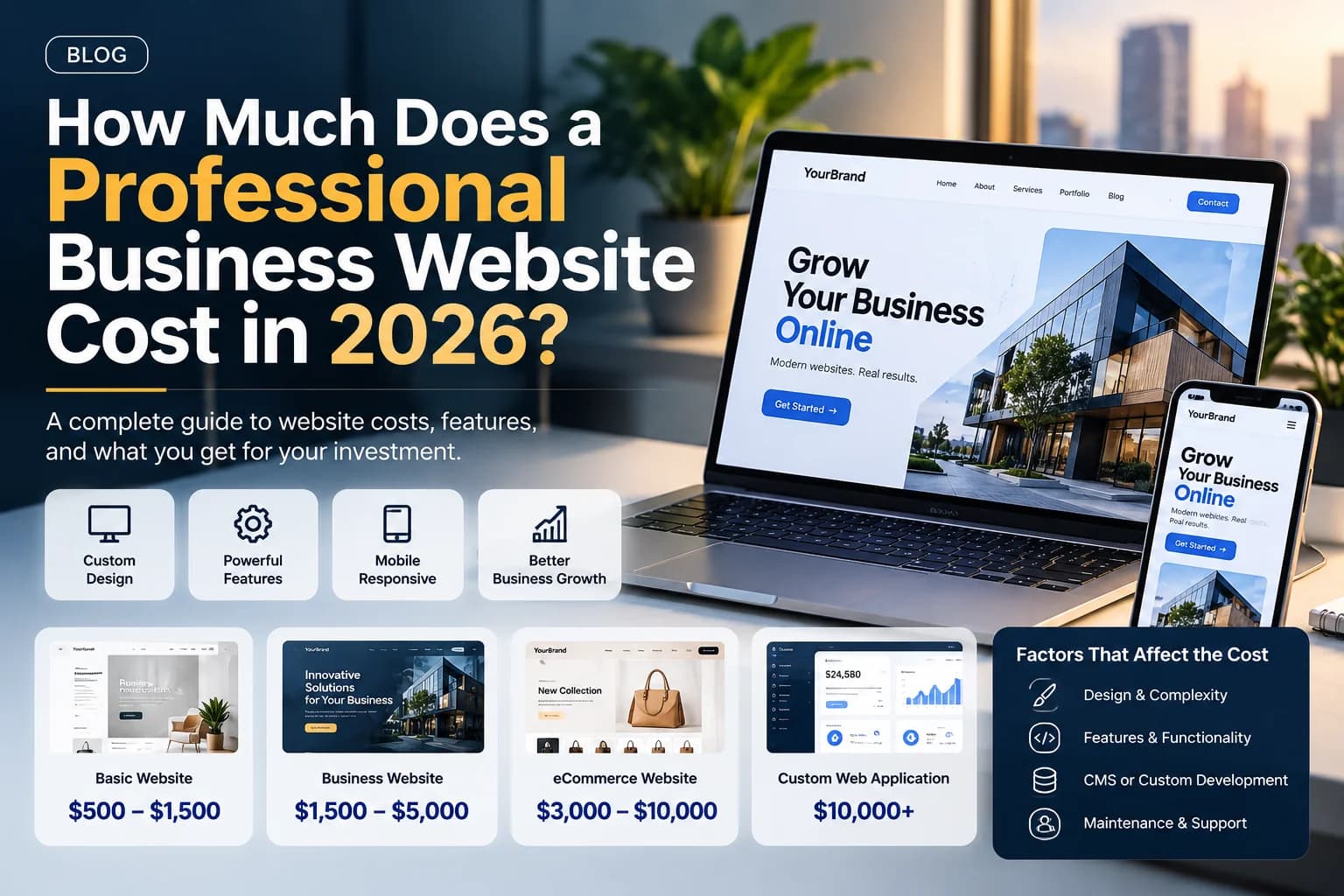
A professional business website in 2026 can cost anywhere from a modest budget for a simple five page site to a serious investment for a custom build with booking systems, integrations and a content platform your team can manage. The honest answer is that price depends on what you need the site to do, not just how it looks. In this guide we break down the real factors that shape website cost, what you should expect at each budget level, and how to avoid paying for things you do not need. If you already know you want a quote, you can skip to the end and talk to our team about your project.
Why website prices vary so much
Two businesses can ask for "a website" and need completely different things. A local clinic that wants five pages and a contact form is a very different project from an ecommerce brand that needs product filters, payment integration and a customer dashboard.
The main factors that decide cost are:
Number of pages and templates. A five page site needs one design system. A thirty page site with case studies, team profiles and a resource hub needs several unique layouts.
Custom design versus templates. A site designed from scratch in Figma around your brand costs more than adapting an existing theme, and it also converts better because every section is built for your customer.
Features and integrations. Contact forms are simple. Booking systems, quote calculators, member logins, CRM connections and payment gateways take real development time.
Content management. If your team wants to edit text, images and blog posts without touching code, the site needs a proper content management system connected to it.
Content creation. Writing copy, sourcing photography and producing graphics are often separate from the build itself.
SEO foundations. Clean code, fast load times, proper heading structure and metadata are what make a site findable on Google. Cheap builds often skip this.
What you get at each budget level
Rather than throwing out exact figures, which depend on your requirements, here is what different budget levels typically buy you in 2026.
Starter level: a simple brochure site
At the entry level you get a clean, mobile friendly site of around five to eight pages: home, about, services, a gallery or portfolio, and a contact page. It usually includes a contact form, basic on page SEO and analytics setup.
This level suits freelancers, consultants and small local businesses that mainly need a credible online presence. The tradeoff is usually a template based design and limited room to grow. If your business plan involves adding a blog, landing pages for ad campaigns or new services within a year, starting slightly higher saves a rebuild later.
Professional level: a custom designed business site
This is where most serious small and mid sized businesses land. You get a custom design created in Figma around your brand, built with a modern framework like Next.js, with ten to twenty pages, a content management system, proper SEO structure, conversion focused layouts and integrations with your CRM or email platform.
At this level the site is designed to do a job: turn visitors into enquiries. That means clear calls to action on every page, fast loading on mobile, landing page templates for campaigns, and tracking so you can see which pages generate leads.
Our own website design and development work sits in this category: the same in house team designs the pages in Figma and builds them in Next.js, so what you approve in design is exactly what goes live.
Advanced level: web apps and complex builds
At the top end you are no longer buying a website, you are buying software. Customer portals, booking platforms with live availability, quote and pricing calculators, multi language sites, membership areas and deep integrations with internal systems all fall here.
These projects are scoped individually because the cost is driven by logic and data, not pages. The good news is that a modern stack like Next.js scales from a simple business site to a full web app without starting over, so a well built professional site can grow into this level later.
The hidden costs people forget
The build quote is not the full picture. Budget for these as well:
Domain and hosting. Annual costs, usually small, but premium hosting that keeps your site fast under traffic costs more than the cheapest plan.
Copywriting. The words on your site do the selling. Professional copy is often the highest return line item in the whole project.
Photography and graphics. Stock photos are fine to a point, but real photos of your team, office and work build trust that stock cannot.
Maintenance and updates. Software needs updates, forms need monitoring, and content needs refreshing. Ask any agency what happens after launch and what support looks like.
Marketing after launch. A new site without traffic is a shop on an empty street. Plan for SEO, paid ads or both so the investment actually pays back.
Cheap websites versus professional ones: what is the real difference?
A very cheap website is not necessarily a bad choice if you are testing an idea. But understand what you are giving up:
Speed. Cheap themes ship with bloated code. Slow sites lose visitors and rank worse on Google.
Ownership of design. Template sites look like thousands of other sites. A custom design is built around your customer's journey, not a generic layout.
SEO foundations. Heading structure, metadata, image optimization, clean URLs and crawlable code are often missing in budget builds.
Conversion thinking. Professional sites are laid out to move a visitor toward an enquiry: clear headlines, proof, and a call to action on every page. Templates just fill space.
Room to grow. A site built on a solid framework can add a blog, landing pages, a CMS or new features without a rebuild. Many cheap builds hit a wall within a year.
The question is not "what is the cheapest site I can get?" It is "what does each enquiry from my website worth, and will this site generate them?" If a new customer is worth thousands to your business, a site that converts twice as well pays for itself quickly.
How to budget for your website in 2026
Here is a practical way to approach it:
Write down what the site must do. List the pages, the features, and the one action you want visitors to take. This becomes your scope.
Separate must haves from nice to haves. Launch with what matters. A phased build costs less up front and lets real visitor data guide phase two.
Ask what is included. Does the quote cover design, development, content, SEO setup, analytics and training? Comparing quotes is only meaningful when the scope matches.
Ask who does the work. Some agencies design in house but outsource development, which is where miscommunication and delays creep in. An in house team that designs and builds means what you approve is what ships.
Plan the follow on budget. Set aside budget for the first three to six months of SEO or ads so the site starts generating returns immediately.
Questions to ask before you sign anything
Will the design be custom, and will I see and approve it before development starts?
What will the site be built with, and can it grow with my business?
Can my team update content ourselves after launch?
Is on page SEO and analytics setup included?
What does support look like after launch, and what does it cost?
Who owns the site, the code and the content if we part ways?
A good agency will answer all of these clearly in a proposal. Vague answers before you pay usually mean vague delivery after.
So, how much should you spend?
Spend enough to get a site that loads fast, looks credible, ranks on Google and is laid out to convert, and no more than that. For most businesses in 2026, that means a custom designed site built on a modern framework, with a CMS so your team can keep it fresh, and a plan to drive traffic once it is live.
The right next step is not guessing at numbers from an article. It is a short conversation about your pages, features and goals, followed by a tailored proposal with a clear quote. That is exactly how we work: share what you need, and we will send a detailed proposal, usually within 48 hours.
Know someone who should read this?