
AI Chatbots
AI Chatbots vs Human Customer Support: Which Is Better?
AI chatbots or human support? Compare speed, cost, accuracy and customer experience, and learn how a hybrid setup gives your business the best of both.
 Tushar MondalCEO & Founder
- Published
- Reading time
- 6 min read
Listen · 6 min
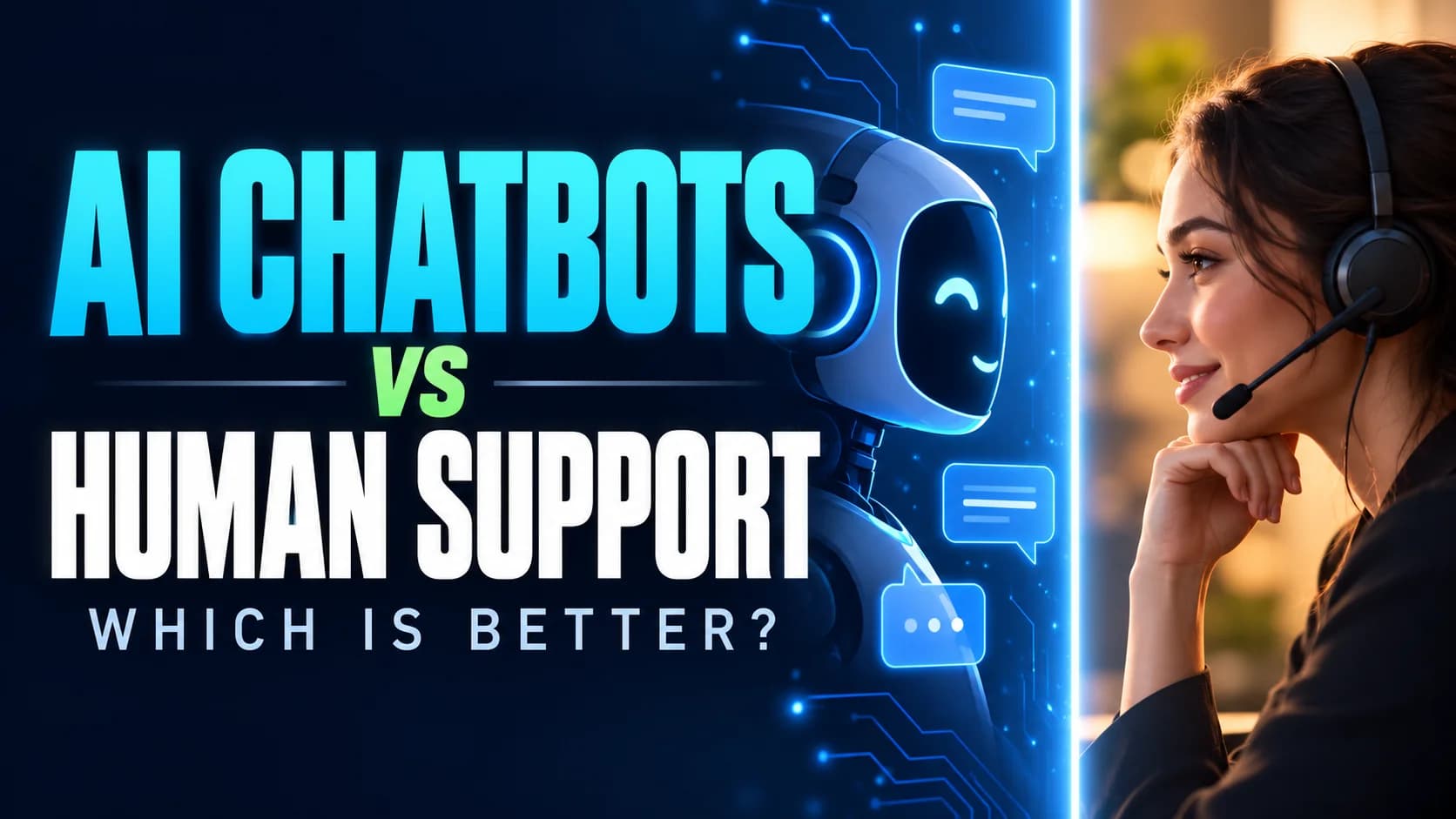
The honest answer is that neither one wins on its own. AI chatbots are better at speed, availability and handling repetitive questions at scale. Human support is better at empathy, judgment and solving unusual problems. For most businesses, the right setup is a chatbot that answers the routine 60 to 80 percent of conversations instantly and hands the rest to your team with full context. This post walks through where each option is stronger, where each one falls short, and how to decide what mix makes sense for your business.
What Each Option Actually Does Well
Before comparing, it helps to be clear about what you are comparing.
AI chatbots are software that answer customer messages automatically. Modern chatbots, like the ones we build on the OpenAI and Claude APIs, are trained on your own business information, so they answer questions about your services, pricing, policies and availability in natural language. They work on your website and on WhatsApp, around the clock.
Human support is your team answering calls, emails, WhatsApp messages and chat themselves. People bring empathy, context from past relationships and the ability to handle anything the script did not predict.
The comparison is not about replacing one with the other. It is about deciding which conversations each one should own.
Where AI Chatbots Win
1. Availability Around the Clock
A chatbot never sleeps, takes lunch or goes on leave. If a potential customer messages your WhatsApp at 11:30 pm asking about pricing, the chatbot answers in seconds. A human team cannot do this without paying for night shifts.
This matters more than most owners realize. A large share of enquiries for local and service businesses arrive outside office hours, and the business that replies first usually gets the conversation. If a real number from our work would help here, it is worth adding one.
2. Instant, Consistent Answers
A chatbot replies in seconds and gives the same correct answer every time. It never has a bad day, never forgets a policy detail and never quotes last year's price by mistake. For questions like "What are your timings?", "Do you serve my area?" or "How much does this cost?", instant and consistent beats human and variable.
3. Handling Volume Without Hiring
One support person can handle a limited number of conversations at once. A chatbot handles hundreds in parallel. During a sale, a festival rush or an ad campaign, the chatbot absorbs the spike without you hiring temporary staff.
4. Lead Capture and Qualification
A well built chatbot does not just answer questions. It collects the visitor's name and number, asks two or three qualifying questions (budget, timeline, requirement), books an appointment into your calendar if you offer that, and pushes everything into your CRM. No lead slips through because nobody was watching the inbox.
5. Cost at Scale
Once built, a chatbot answers the thousandth question for roughly the same cost as the first. Human support costs grow with every additional conversation. For businesses where most enquiries are repetitive, the math favors automation for the routine layer.
Where Human Support Wins
1. Empathy and Emotional Situations
When a customer is upset, confused or dealing with a sensitive issue, they want a person. A chatbot that responds to a complaint with a cheerful scripted answer makes things worse. Humans read tone, apologize sincerely and de escalate. No chatbot does this convincingly today.
2. Complex, Unusual Problems
Chatbots answer from the material they were trained on. When a problem falls outside that material, a human who can investigate, make judgment calls and bend a policy when it makes sense is irreplaceable.
3. High Value Sales Conversations
If you sell something expensive or customized, such as a software project, a property or a wedding package, the closing conversation needs a person. Buyers at that level expect to negotiate, ask detailed questions and build trust with a human before committing.
4. Relationship Building
Repeat customers often want to talk to "their person". Relationships built over conversations are a real competitive advantage, and they happen between people.
The Mistake: Treating It as Either Or
Businesses usually make one of two mistakes.
The first is going all human. Every WhatsApp message waits for someone to check the phone. Leads that arrive at night get answered the next morning, by which time the customer has often messaged a competitor. The team spends most of its day answering the same ten questions.
The second is going all chatbot. The bot answers everything, including complaints and edge cases it was never trained for, and there is no easy way to reach a person. Customers leave frustrated, and the bot becomes a wall instead of a front door.
The setup that works is a hybrid: the chatbot owns the first response and the routine conversations, and your team owns everything that needs judgment or empathy.
What a Good Hybrid Setup Looks Like
Here is how we typically structure it for clients:
The chatbot answers first, instantly. On your website and WhatsApp, every message gets an immediate, helpful reply trained on your services, pricing, policies and FAQs.
It qualifies and captures. It collects contact details, asks a few qualifying questions and, where relevant, books an appointment directly into your calendar.
It recognizes its limits. When the conversation involves a complaint, a custom requirement, a negotiation or anything outside its training, it hands over.
It hands over with context. Your team receives the full conversation history, so the customer never has to repeat themselves. This single detail is the difference between a handover that feels seamless and one that feels like starting over.
Your team steps in where they add value. Free from repetitive questions, they focus on closing sales, solving real problems and keeping unhappy customers.
The result: customers get instant answers at any hour, and your team's time goes to the conversations that actually need them.
Questions to Ask Before You Decide
If you are weighing chatbot versus human support for your business, work through these:
What share of our enquiries are repetitive? If most incoming questions are about pricing, timings, location, availability or order status, a chatbot will pay for itself in recovered time and recovered leads.
When do our enquiries arrive? Check your WhatsApp and website enquiries by hour. If a meaningful share arrives outside office hours, you are losing leads every night.
How fast do we currently respond? Speed to first response is one of the strongest predictors of whether an enquiry converts. A chatbot makes it instant.
Which conversations must stay human? Complaints, refunds, high value deals and sensitive topics should always have a fast path to a person.
Where does lead information go today? If details live in a WhatsApp chat history or a notebook, a chatbot connected to your CRM fixes a real operational gap.
What a Modern Chatbot Actually Is (and Is Not)
Many owners picture the clunky bots from a few years ago: rigid menus, "Sorry, I didn't understand that," dead ends everywhere. That is not what we build.
A modern AI chatbot is trained on your own business information: your services, pricing, policies, FAQs and processes. It understands questions phrased a hundred different ways and answers in natural, conversational language. On WhatsApp, we build on the official WhatsApp Business API, the same platform behind Splashify Pro, a WhatsApp chatbot product our own team built, so delivery is reliable and your number stays in good standing.
It is also not a set and forget tool. It needs your real business information to be useful, periodic updates when your pricing or policies change, and clear rules for when to hand over to a human. Done properly, it becomes the most reliable member of your front line team.
The Bottom Line
AI chatbots are better at speed, availability, consistency and scale. Humans are better at empathy, judgment and complex, high value conversations. The businesses getting this right are not choosing one over the other. They let a chatbot handle the routine 60 to 80 percent of conversations instantly and at any hour, and they free their team to handle the rest with the full context of every conversation. That combination is what customers now expect: an instant answer first, and a person when it matters.
Know someone who should read this?